
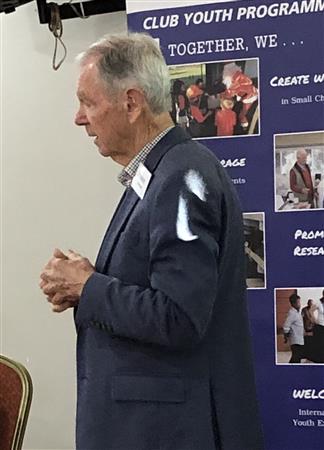
John Adeney is a frequent visitor to our Club, but this time he was our Guest Speaker! John retired from the CSIRO about three years ago, and he decided to take up beekeeping using his daughter and son-in-law’s property at Burekup – about 100 kms south of Perth. John has established three beehives and he uses time honoured collection methods – taking the honeycombs out of the hive and scraping the honey into a bucket. Modern style beehives were first used in the 19th Century and the early 1900s, and these evolved into the current structure, namely a vertical modular beehive containing hung frames. The lower area is the Brood Chamber where the bees come and go and the Queen resides, and the upper area is the Honey Chamber where the honey is stored. Australian native bees don’t sting but they also don’t produce much honey, so the focus is on the introduced European Honey Bee which can be a prolific producer but also has a significant sting! There are three roles in the hierarchy, namely the Queen, Drones (who mate with the Queen and are cared for by the Workers), and Workers (which are sterile females which collect the pollen). The Workers collect the pollen, carry it on their legs, and then deposit it in the honeycombs. They eat the pollen and regurgitate it several times, and as the water evaporates, the honey becomes stronger. In WA the bees like Jarrah and Marri pollen as well as Grevillea and Cape Weed. Equipment must be kept clean, otherwise diseases can be introduced. Another danger is high wind. John fielded many questions to end this interesting expose!